
November 18, 2026
The concrete looks dry. Your timber boards are ready. Then your installer asks whether the slab needs a primer, a moisture barrier or both. What’s the difference?
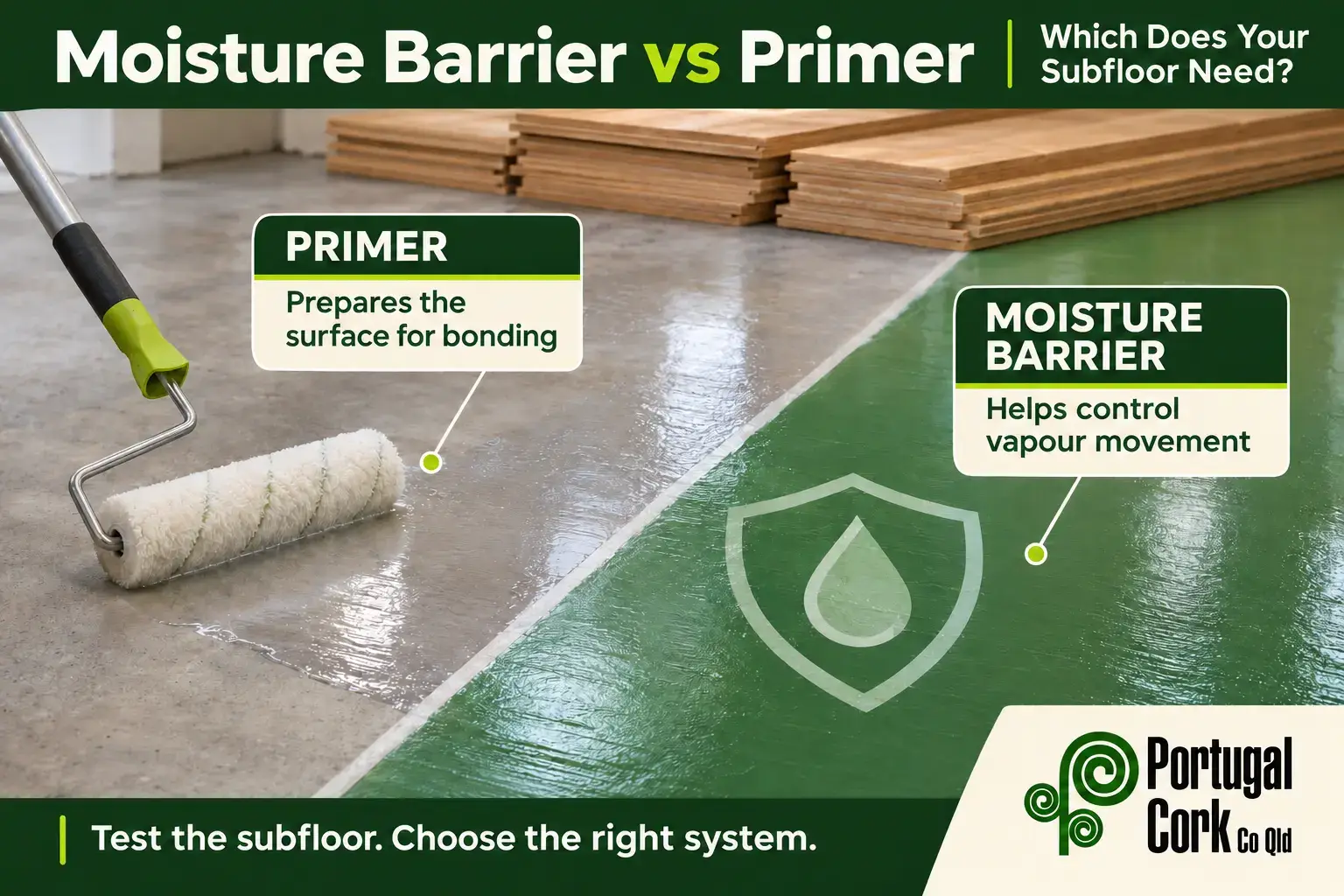
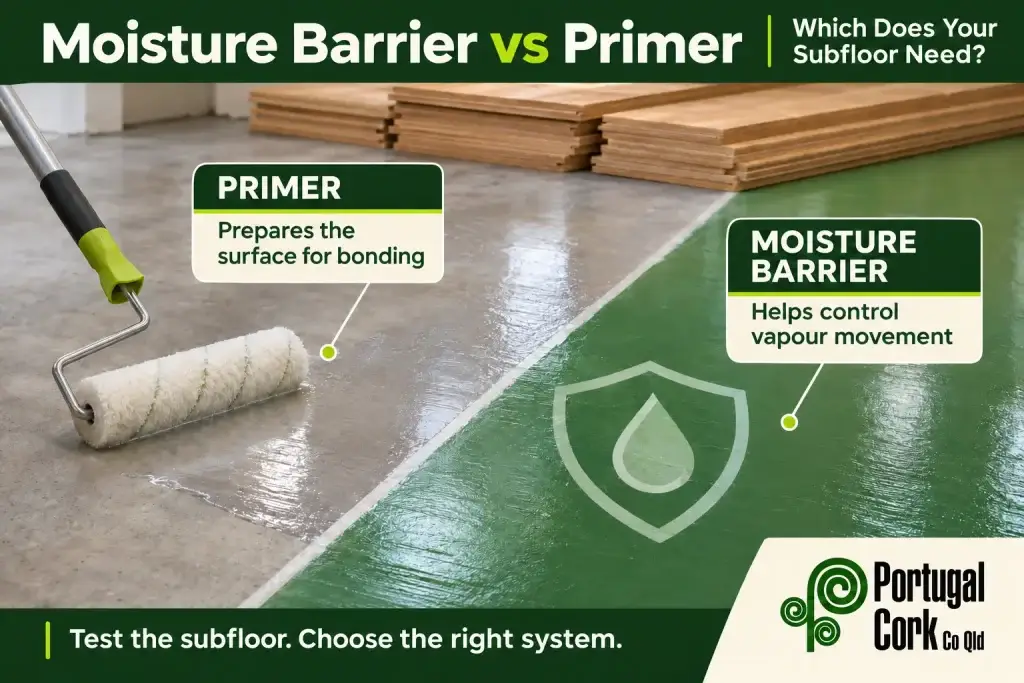
A floor primer prepares the subfloor so a compatible adhesive or levelling layer can bond. A moisture vapour barrier helps limit moisture moving through concrete, within the product’s stated conditions. Some specialist products can do both, but a normal primer is not automatically a moisture barrier.
If you’re comparing a moisture barrier vs primer for timber flooring, start with the subfloor and the flooring system, not the product label. A few checks now can prevent a costly mistake later.
Think of primer as preparation for what comes next. Concrete can be porous, dusty or uneven in how it absorbs liquids. A suitable primer can help manage that absorption and create the bonding conditions required by an approved adhesive or levelling product.
But priming alone doesn’t prove the slab is dry enough for timber. If moisture protection is needed, a standard bonding primer may not provide it.
Concrete can hold water left from construction or allow moisture vapour to move up from below. A suitable subfloor moisture barrier is made to control that movement so a compatible floor system can be installed within specified limits.
It isn’t the same as structural waterproofing. A leaking pipe, active water entry or a failed building damp-proof system needs its cause checked and dealt with first.
Yes. Some polyurethane primers and epoxy systems have a stated moisture-control role as well as a preparation role. Others need a separate compatible primer, or a particular adhesive over the barrier.
The table compares what each function is meant to do. It doesn’t mean every product belongs in only one column.
| Consideration | Conventional floor primer | Suitable moisture barrier |
|---|---|---|
| Main purpose | Prepare the surface for bonding or later layers | Control specified moisture vapour movement |
| What determines selection? | Surface porosity, condition and next product | Moisture results, substrate and flooring system |
| Moisture protection | Not automatically provided | Product-specific, with limits and conditions |
| Can it replace the other? | Only if expressly approved for both uses | May still need compatible priming or preparation |
Timber takes in and releases moisture as conditions change. Too much moisture beneath a floor can lead to swelling, cupped boards, lifting or trouble with the adhesive. Engineered timber is often more stable than solid boards, but it still has limits.
You may not see a warning sign at first. A slab can look dry on top while moisture remains deeper inside it. That’s why appearance is not a reliable moisture test.
A new slab may still be drying after construction. An old slab might receive ground moisture, or water may be entering through a leak. These aren’t the same problem, even if the floor feels damp in each case.
A product approved for residual slab moisture isn’t a quick fix for standing water or ongoing leaks. Find the source before choosing a treatment.
No, not every slab needs a separate barrier. What it does need is an assessment suited to the timber floor and the products being used. An installer should check moisture using the method required by the relevant manufacturer and record the results.
Those readings are then compared with the limits for the timber, preparation system and adhesive. There isn’t one safe moisture number that fits every type of slab or installation.
A new slab may contain moisture from the pour. An older slab can still have a moisture problem, especially if conditions below it have changed or its original damp-proof protection is uncertain. Age alone doesn’t decide whether a concrete moisture barrier for timber flooring is needed.
Plywood, particleboard and timber boards need their own checks for moisture, movement, strength and, where relevant, ventilation. Don’t put a product approved for concrete straight onto a timber subfloor without written confirmation that it’s suitable.
Wakol PU 280 is a polyurethane primer with moisture-control applications. Its use as an ordinary primer differs from its use as a moisture barrier, including the surface preparation and coating requirements. Check the current technical data sheet for the exact product supplied in Australia, including the approved moisture-test method and compatible next layers, before selecting the system.
Sika Fast Barrier 158 W is a two-component, water-based epoxy moisture barrier. Sika specifies that it is for use by experienced professionals and in combination with compatible products from its approved flooring ranges. This makes the next layer just as important as the barrier itself.
Bostik Ultraset 3 in 1 combines timber flooring adhesive with moisture-control and sound-reduction functions. To achieve its moisture and sound-control performance, it must be applied using Bostik’s specified method, including the correct notched trowel and required coverage. Using it only as an adhesive does not automatically provide the same membrane performance. Proper slab preparation and flooring-system checks are still essential.
Picture two rooms with similar-looking concrete. One has a sound, dry slab but a surface that needs priming before a levelling compound is applied to create a flatter surface. The other has moisture readings that call for a suitable barrier. They look alike but may need different preparation.
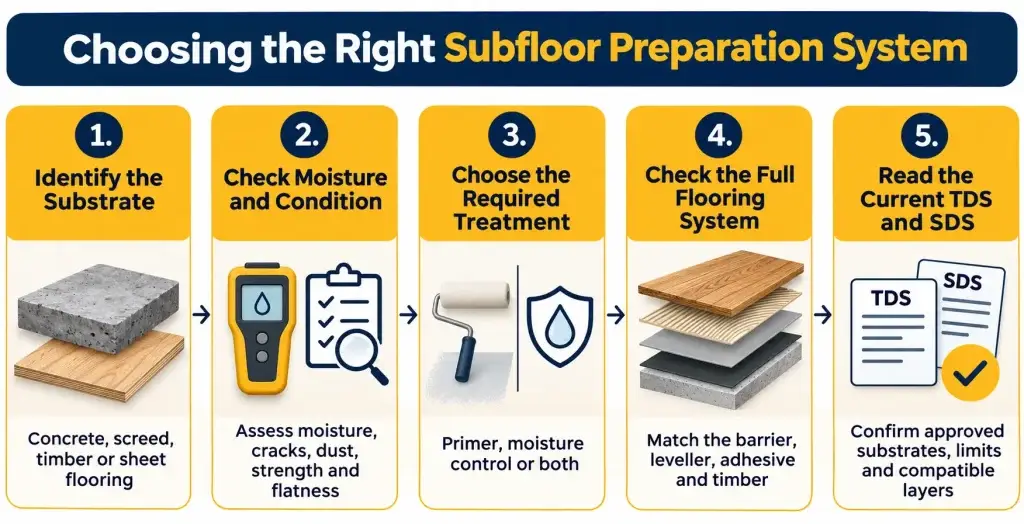
Arrange the right moisture assessment. Check whether the surface is sound, clean and flat enough. Cracks, weak concrete, old adhesive and dust may need attention even when the moisture result is acceptable. If you’re renovating, read Portcork’s guide to preparing a subfloor after removing cork flooring.
Match the substrate, primer or barrier, leveller if needed, adhesive and timber boards. Products that work well on their own may not work together. Don’t mix brands or swap steps unless the manufacturers approve the combination.
Look for approved substrates, moisture-test methods, surface preparation, heating restrictions and compatible next layers. Use the current technical data sheet (TDS) and safety data sheet (SDS), rather than a rule borrowed from another product.
Only if that exact primer is approved for moisture control and the slab meets its conditions. A standard bonding primer should not be used as a substitute just because it’s sold for concrete.
It depends on the slab moisture, the installation method and the engineered board and adhesive requirements. Engineered timber isn’t immune to moisture damage, so don’t skip the assessment.
Certain products are designed for assessed damp or recently placed concrete, but only within stated conditions. Standing water, leaks and ongoing water entry need separate investigation. A damp-looking slab is not enough information to choose a product.
As a rough industry rule of thumb, concrete takes approximately one month per 25mm of slab thickness to dry under favourable conditions, meaning a 100mm slab often takes at least four months. However, weather, ventilation and concrete mix design vary widely, so you should always rely on calibrated moisture testing rather than the calendar before installing timber.
The right product depends on what is beneath the timber, not just the label. Explore Portcork’s moisture membranes and primers, or contact the team with your subfloor type, moisture results, timber flooring choice and planned adhesive. They can help you narrow down product options and the manufacturer documents to check before you buy.