You can spend weeks picking the perfect timber, hybrid plank, or tile for your flooring project – and still end up with a floor that thuds, echoes, and feels cold underfoot in winter. That’s because the thing doing most of the work isn’t the surface at all. It’s what’s hiding beneath it.
If you’ve ever lived above a noisy neighbour, or been the noisy neighbour yourself, you already understand the problem. Standard foam underlay can only do so much. Cork underlay – and cork underlayments more broadly – were solving this problem long before “acoustic compliance” became a line item in strata by-laws.
Here’s why it works, how it compares to rubber and rubber-cork hybrid options, and how to install it properly so you actually get the noise reduction and thermal insulation you paid for.
How Cork Actually Stops Noise
Floor noise comes in two flavours, and it helps to know the difference before you start shopping:
- Impact sound – footsteps, dropped keys, heavy furniture being dragged across the floor.
- Airborne sound – voices, music, the TV bleeding through to the room below.
Cork deals with both because of how it’s built. Slice it open and you’ll find millions of tiny, air-filled cells packed together like a natural honeycomb. When a sound wave or a footstep hits the floor, those cells compress and absorb the energy instead of bouncing it straight back up – or through the slab to the apartment below. That’s the basic mechanism behind any good acoustic underlay, and it’s why natural cork has been used for sound insulation for well over a century.
For anyone working to strict strata soundproofing requirements, or just tired of hearing every step from upstairs, that cellular structure delivers real, measurable acoustic performance – not just marketing-brochure promises
The Bonus Nobody Mentions: Thermal Comfort
Sound insulation gets all the attention, but cork’s air-filled structure does double duty as a thermal barrier – and this is where a lot of homeowners get a pleasant surprise.
Concrete subfloors are brutally efficient at moving temperature in the wrong direction. In winter, they pull warmth straight out of a room. In summer, they let outside heat creep in. A layer of cork underlay breaks that thermal bridge and adds genuine thermal insulation, so your floor stops working against your heating systems and air-conditioning.
The flow-on effect is fewer hours spent running the heater or the air-con just to feel comfortable – which is a nice, quiet win for your power bill too. It’s also worth noting that cork is harvested from the bark of the cork oak tree without felling it, which makes it a renewable resource and a genuinely eco friendly choice compared with petroleum-based foam underlays.
What Floors Pair Well With Cork
Cork underlay isn’t fussy about what goes on top of it. It works underneath:
- Floating floor systems, timber, and hybrid flooring – it kills the hollow “clicking” sound that gives floating floors away and makes the whole floor feel more solid underfoot, even in high traffic areas like hallways and living rooms.
- Tiles – used as a cork underlayment, it helps absorb minor subfloor movement so it doesn’t telegraph up as hairline cracks in your tiles.
- Carpet – layered under your carpet pad, it adds an extra hush to bedrooms, home offices, or media rooms.
When You Need More: Layering Cork With Rubber
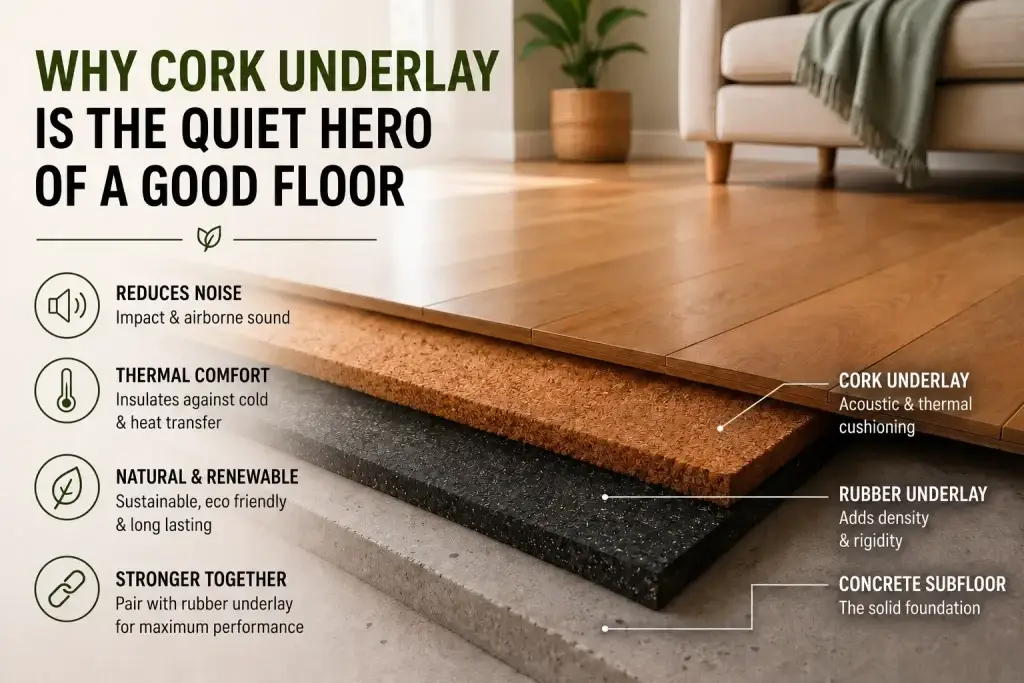
For spaces with serious acoustic demands – a home theatre, a music room, or an apartment with tight strata sign-off requirements – cork underlayment alone might not be enough, and that’s where pairing it with a rubber underlay comes in.
This combined build-up is often what people mean when they search for a rubber cork acoustic underlay or a damtec acoustic underlay system. PortCork’s Damtec Acoustic Rolls are a good example: a dense, 100% rubber compound (around 970kg/m³) that adds structural rigidity beneath the cork. Stacked together, the build-up typically looks like this, from the subfloor up:
- Concrete subfloor
- Damtec acoustic rubber roll (adds density and rigidity)
- Cork underlay (adds acoustic and thermal cushioning)
- Your finished timber or hybrid floor
That combination resists deflection under heavy furniture and concentrated point loads – think bookshelves, pianos, or busy foot traffic – while maintaining strong acoustic insulation across the whole system.
Getting the Install Right (So You Don't Waste the Material)
Cork performs best when it’s installed properly. A few things genuinely matter here:
Let it acclimatise first. Cork is a natural material, and it adjusts to the humidity of the room it’s going into. Leave your rolls or sheets flat in the space for at least 48 hours before laying anything.
Prep the subfloor properly. It needs to be flat, dry, clean, and free of debris – sand down high spots, fill in low ones, and always run a moisture barrier over concrete before you start.
Use the right adhesive. This is where a lot of DIY installs go wrong. Cheap, water-based glues can make cork swell and warp over time, which undoes all the benefit of installing it in the first place. A purpose-built adhesive like Wakol MS260 is formulated specifically to bond cork to timber substrates without off-gassing issues.
Leave room to breathe. Keep a 2-3mm expansion gap around the room’s perimeter (your skirting boards will hide it). For extra acoustic isolation, run a strip of 12mm expansion cork along the edges to stop vibration from transferring into the walls.
The Takeaway
A quiet, well-insulated room isn’t an accident – it’s built from the subfloor up. Cork underlay does the heavy lifting on noise reduction and thermal comfort, and when paired with the right rubber underlay and adhesive, it turns an ordinary floor into one that actually feels and sounds premium, while staying a renewable, eco friendly choice.
Whether you’re after rolls of natural cork for a large open-plan space, a damtec acoustic underlay for serious soundproofing, or the right Wakol adhesive to lock it all together, PortCork ships premium, sustainable cork underlayments Australia-wide.