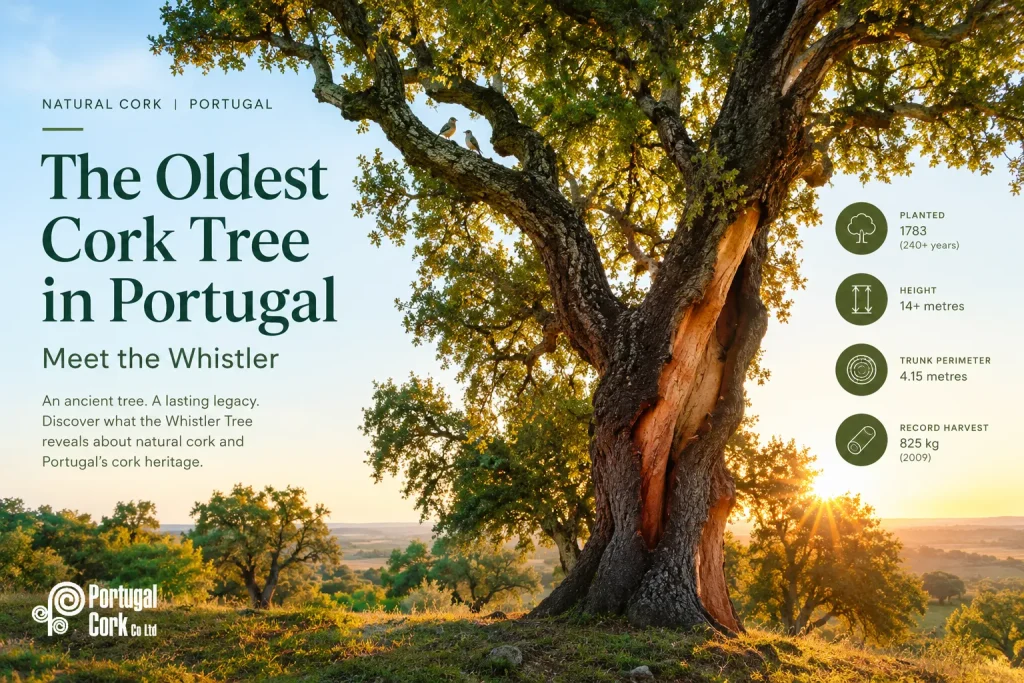
A bird lands on a high branch in Águas de Moura, soon joined by another. Before long, birdsong echoes through the massive canopy. This simple, everyday sound gave one remarkable cork oak its name: Assobiador, or the Whistler Tree.
Planted in 1783, the Whistler has stood for more than two centuries. Today, Portuguese Cork Association recognises it as the world’s largest and oldest cork oak.
Yet its age is only the beginning of its story.
Whistler Tree Fast Facts
- Name: The Whistler Tree (Sobreiro Assobiador)
- Planted: 1783, making it more than 240 years old
- Location: Águas de Moura, Portugal
- Height: More than 14 metres
- Trunk perimeter: About 4.15 metres
- Record: Produced 825 kg of raw cork in its 2009 harvest
The Cork Tree That Learned to Whistle
The Whistler Tree grows near Palmela, in Portugal’s Alentejo region. Its broad branches offer a resting place for countless songbirds. Their calls inspired the tree’s Portuguese name, Assobiador, meaning “whistler”.
It’s a gentle name for a giant.
Families have grown old around this tree. Roads, towns and farming methods have changed. Still, the Whistler remains rooted in the same soil.
A Record Harvest From One Ancient Oak
The oldest cork tree in Portugal is more than a natural landmark. It remains a productive tree.
Its bark has been harvested more than 20 times. In 2009, the Whistler produced 825 kilograms of raw cork. That was enough to make around 100,000 wine stoppers.
Guinness World Records recognises this as the largest cork yield from a single tree.
While the Guinness World Record is impressive, the real wonder of the Whistler Tree is much quieter. After each careful harvest, the tree remained standing and grew another protective layer of bark.
Why the Whistler Tree Matters
In 1988, the Whistler was classified as a Tree of Public Interest in Portugal. Thirty years later, it was voted European Tree of the Year.
Those honours recognise more than size.
The tree has become a living symbol of Portugal’s relationship with the cork oak. It shows what can happen when a natural resource is managed with patience, skill and respect.
A cork oak tree isn’t felled during a proper harvest. Skilled workers remove its outer bark, then leave the tree to regenerate. Portuguese rules require at least nine years between harvests.
You can explore this process in Portcork’s guide to how high-quality Portugal cork travels from bark to finished product.
What the Whistler Tree Reveals About Portugal Cork
The Whistler Tree tells a larger story about Portugal cork.
Natural cork doesn’t come from cutting through the tree’s trunk. It comes from bark that can grow again. The process is slow, and it cannot be rushed.
That may feel unusual in a world built around speed. Yet patience is one reason cork has remained useful for generations.
The Whistler has lived through repeated harvest cycles while continuing to shelter birds and form part of the surrounding cork forest in Portugal. Its story makes the renewable nature of cork easier to see. It isn’t simply a claim printed on a product label. It’s visible in a living tree planted in the eighteenth century.
Why This Matters Beyond Portugal
Cork oak forests store carbon as they grow. They also provide habitat, protect soil and help support healthy landscapes.
Because cork bark can be harvested without cutting down the tree, the same cork oak can remain standing through many harvest cycles. For Australian homeowners and designers choosing natural materials, the Whistler Tree offers a powerful example of how cork production can work alongside the life of the forest.
From an Old Tree to a Modern Australian Home
The cork used in flooring today won’t necessarily come from the Whistler Tree. That isn’t the point.
The tree represents the same natural material found in cork flooring, underlay and other products. Its long life shows how cork can connect traditional land care with practical modern uses.
The Whistler Tree’s age doesn’t mean a cork floor will last for centuries. It does, however, show the resilience of the natural material. Cork’s cellular structure gives flooring its comfortable feel and ability to recover from light pressure. Its service life will depend on the tile construction, installation, protective finish and ongoing care.
For Australian homeowners, designers and flooring professionals, that history adds meaning to the material beneath their feet. Cork isn’t made to imitate timber, vinyl or stone. It has its own origin, texture and character.
Bring the legacy of Portugal cork into your space
Frequently Asked Questions