
May 11, 2026
Buying a professional floor sander is rarely a quick decision.
Whether you work in timber restoration, parquet finishing, cork flooring, or surface preparation, the right machine can shape the speed, finish quality, and versatility of your work for years to come.
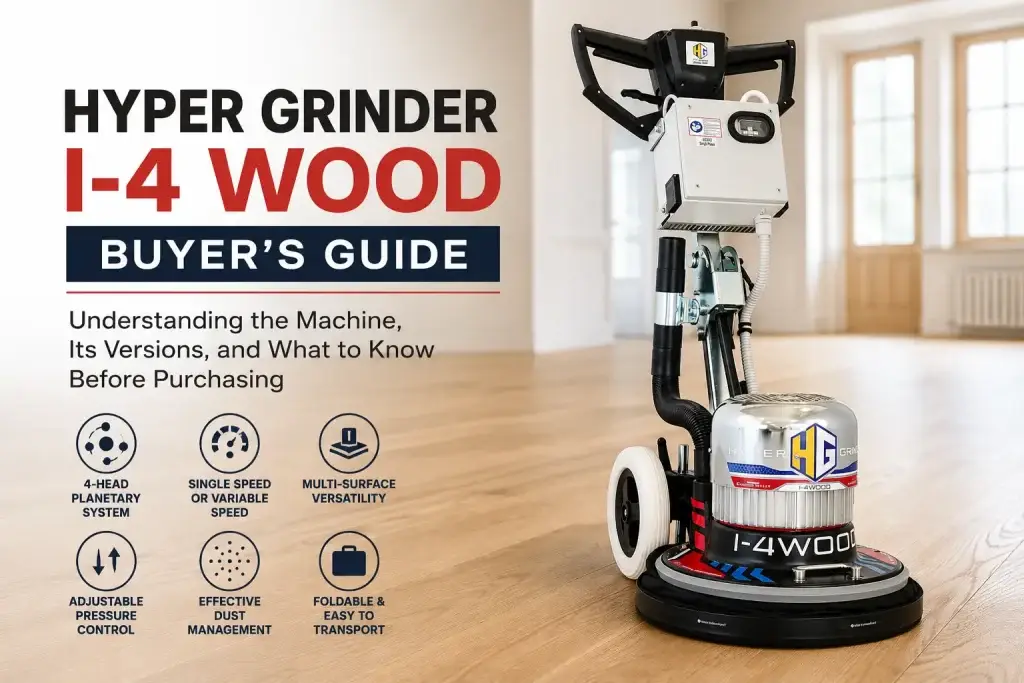
The Hyper Grinder I-4 WOOD has gained attention as a multi-purpose planetary sander designed for precision work rather than aggressive grinding.
But before investing, most buyers ask the same questions:
This guide breaks down the machine in a practical, easy-to-scan way — helping you understand what the I-4 WOOD is designed for, who it suits best, and how to decide between the single-speed and variable-speed models.
If you want the short answer first, here it is.
The Hyper Grinder I-4 WOOD is best suited for:
It is not designed as a heavy industrial concrete grinder.
Instead, it sits in a specialised category — combining sanding, refining, brushing, and finishing into one adaptable machine.
The Hyper Grinder I-4 WOOD is an Italian-made professional planetary floor sander designed for wood, parquet, cork, and delicate floor restoration.
Unlike traditional drum sanders, the I-4 WOOD uses a four-head counter-rotating planetary system.
This creates a more balanced sanding action across the floor.
Rather than relying on one aggressive sanding drum, the machine distributes pressure across four working heads.
This approach can help reduce uneven sanding patterns while creating a smoother, flatter finish.
According to manufacturer documentation, the machine is designed for:
Its compact footprint and foldable handle also make it easier to transport between jobs compared to larger industrial machines.
Traditional sanding machines usually rely on a single rotating drum or disc.
That design works well for aggressive removal but can sometimes leave visible sanding patterns or create directional pull.
The I-4 WOOD approaches sanding differently.
Its planetary system rotates four smaller heads beneath a central plate.
The main plate rotates in one direction while the satellites rotate in the opposite direction.
This creates a more balanced sanding pattern.
For operators, this often means:
Because pressure is spread across multiple sanding points rather than one concentrated drum, the machine may feel smoother to operate during delicate restoration work.
The machine’s flexibility comes from interchangeable tooling and accessory compatibility.
This allows operators to switch between preparation, sanding, refinement, and finishing stages using the same platform.
| Feature | Single-Speed Version | Variable-Speed Version |
|---|---|---|
| Ease of Use | Very Simple | More Adjustable |
| Speed Control | Fixed | Adjustable |
| Best For | Standard sanding | Restoration & finishing |
| Surface Sensitivity | Moderate | Excellent |
| Flexibility | Moderate | High |
| Ideal Buyer | Contractors wanting simplicity | Professionals needing versatility |
The single-speed model is the simpler option.
It runs at one fixed speed, making operation straightforward and predictable.
For contractors who mainly perform standard sanding work, this may be all that’s needed.
There is no need to adjust machine speed between surfaces.
This can simplify workflow and reduce setup decisions.
The trade-off is flexibility.
Because speed cannot be adjusted, operators may have less control during delicate finishing or restoration work.
The variable-speed version includes adjustable rotational speed control.
This allows the operator to change how aggressively or gently the machine behaves depending on the flooring surface.
For restoration professionals, this added control often becomes one of the machine’s biggest advantages.
Different materials react differently to sanding.
Variable speed allows operators to slow the machine down for delicate work or increase efficiency during preparation.
Lower speeds can improve refinement during final sanding or oil application.
Variable speed introduces more control options.
While adjustment is simple, achieving the best results often comes with operator experience.
For many professionals, variable speed becomes the preferred long-term investment because it expands what the machine can do.
Allows pressure adjustment depending on surface sensitivity.
Raised wheels improve manoeuvrability.
Lowered wheels increase pressure during heavier sanding.
One of the biggest strengths of the I-4 WOOD platform is flexibility.
The machine supports a wide range of accessories.
This means the machine can adapt to different workflows rather than forcing operators into one sanding method.
Yes.
Because cork is softer than hardwood, balanced sanding becomes especially important.
The planetary system helps distribute pressure more evenly compared to aggressive drum sanding.
In many workflows, yes.
Because the I-4 WOOD supports sanding, brushing, preparation, finishing, and oiling accessories, it can reduce the need for multiple dedicated machines.
Compared to larger industrial grinders, the I-4 WOOD has a compact frame and foldable handle designed to improve portability.
For contractors performing restoration work across multiple surfaces, variable speed often becomes a major advantage.
For straightforward sanding-only work, single speed may be enough.
This section matters.
Not every machine suits every buyer.
The I-4 WOOD may not be ideal if:
This is a professional restoration tool.
It performs best when used regularly and across multiple flooring environments.
For flooring professionals, the answer often comes down to versatility.
The I-4 WOOD is not purely a sanding machine.
It is not strictly a finishing polisher.
Instead, it sits between those categories — offering preparation, sanding, refinement, brushing, and finishing within one platform.
For contractors working across timber, parquet, cork, and restoration projects, that flexibility can become a major advantage.
The choice between single speed and variable speed ultimately depends on workflow.
If simplicity matters most, single speed may be enough.
If adaptability matters more, variable speed may offer stronger long-term value.
The best purchasing decisions rarely come down to specifications alone.
They come from understanding how a machine fits into the work you actually do.