

September 17, 2026
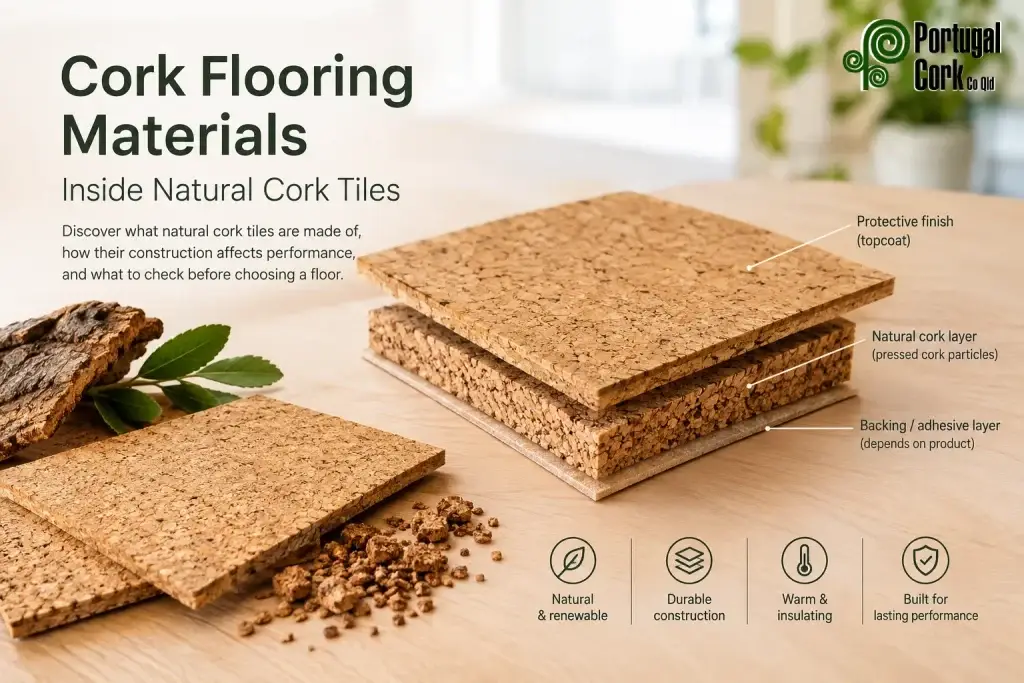
From above, a floor might seem quite simple, a smooth surface, a warm hue, or a pattern perfectly suited to your space. But just beneath your feet, the material holds a unique story.
Understanding cork flooring materials helps you select the perfect product, properly prepare your subfloor, and prevent unexpected issues during installation. So, what exactly goes into a natural cork tile?
Cork is harvested from the outer bark of the cork oak tree. This bark features a unique cellular structure largely comprised of air, granting cork its signature lightweight, resilient, and insulating properties.
Unlike solid timber, cork flooring doesn’t display long wood fibers or traditional grain. Instead, it forms a speckled, highly textured pattern created by natural cork particles, ensuring that no two tiles are exactly alike.
You can learn more about the material’s origin in Portcork’s guide, From Bark to Finished Product: How Portugal Cork Is Made.
But for anyone buying a floor, the next logical question is: how does this raw material transform into a finished tile?
Most natural cork tiles are made from cork particles pressed together with a suitable binder. Heat and pressure help form them into a firm, stable sheet that can be cut to size.
The size and arrangement of the cork particles can influence the finished pattern. Some tiles appear fine and even. Others show larger pieces and stronger natural variation.
This means cork flooring materials shouldn’t be judged by colour alone. Buyers should also consider:
These details shape how the product should be installed and used.
Two tiles may look similar but feel quite different once installed.
Density describes how much material is packed into a given space. A denser tile generally feels firmer and may be designed for more demanding settings. Thickness can affect the floor’s height, feel and installation requirements.
Portcork’s Standard Cork Tiles measure 300 mm by 300 mm and are 6 mm thick. They are listed as high-density tiles suitable for domestic and commercial installations.
A carton contains 50 tiles and covers 4.5 square metres. These details matter when calculating quantities and checking how the new floor will meet doors, trims and nearby surfaces.
A cork tile cannot perform properly if it doesn’t bond well to the surface below.
Portcork’s Standard Cork Tiles come pre-glued with contact adhesive. However, the complete installation still depends on a clean, dry, firm and suitably level subfloor. The installer must follow the product instructions and use any compatible primer or additional adhesive required by the system.
Concrete, timber and plywood can each need different preparation. Moisture, dust, movement or uneven areas should be addressed before installation begins.
Explore Portcork’s timber and cork adhesives and levelling compounds when planning your installation. Always confirm compatibility before using any product.
The raw cork is only one component of the finished floor. The protective topcoat also plays an important role.
A suitable finish helps protect the surface from everyday wear, dirt and spills. A site-applied polyurethane coating may also help seal the joints between tiles after installation.
This is especially important because cork is a natural material. It should not be left exposed to excessive moisture or cleaned with unsuitable products.
When comparing cork flooring materials, ask whether the tiles are unfinished, pre-finished or require another coating after installation. Don’t assume every product follows the same system.
The term “cork” encompasses a variety of formats, but they are not interchangeable.
You cannot simply swap one format for another. Always review the product specifications, intended application, and installation guidelines before purchasing.
The best flooring decisions start long before you pick out a color.
Take the time to understand the tile’s construction, evaluate its density and thickness, identify the required adhesive system, and determine the necessary finish. These technical details provide far more insight than a simple product photo ever could.
Ready to take a closer look? Explore Portcork’s Standard Cork Tiles or contact the Portcork team for help with product quantities, preparation and installation requirements.
Yes. Portcork’s Standard Cork Tiles are crafted from genuine natural cork that has been formed into stable, high-density tiles. This delivers the inherent warmth and unique character of cork in a highly practical format for both domestic and commercial spaces.
Not necessarily. Thickness is just one variable. The tile's density, overall construction, subfloor preparation, adhesive system, and surface finish all collectively determine the quality of the completed floor.
No, cork rolls and finished cork tiles are manufactured for entirely different purposes. You should only use a product as a flooring surface if the supplier explicitly confirms it is designed for that application.