
September 2, 2026
In a Portuguese cork forest, one number tells an important story.
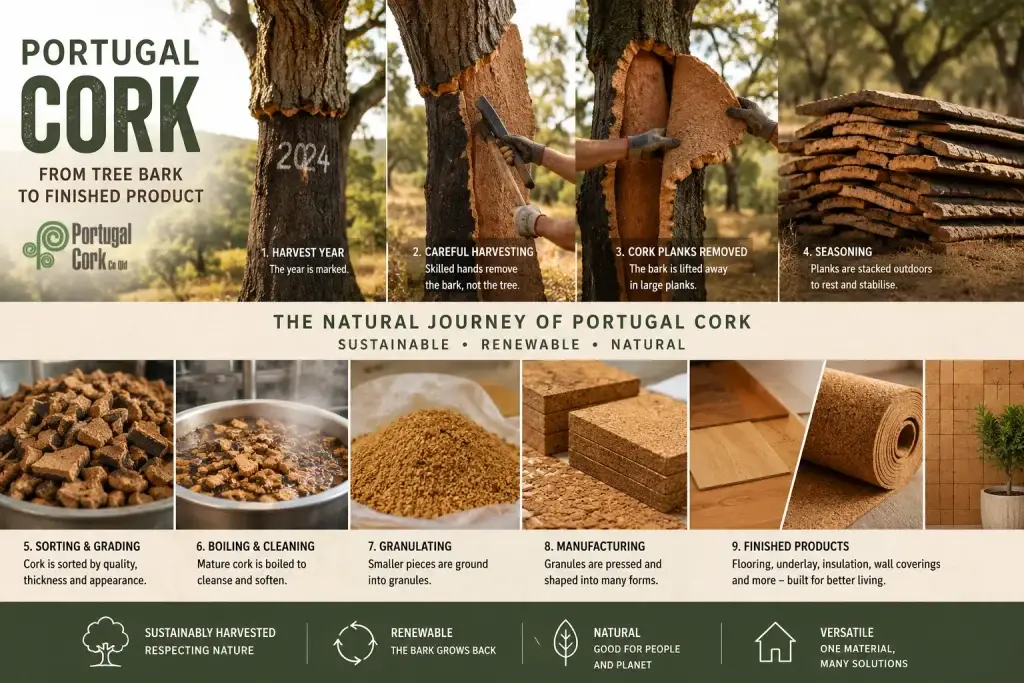
It is painted onto a cork oak after its bark has been removed. The number records the harvest year, reminding workers that the tree must be left alone for at least nine years before the next harvest.
This patient relationship between people and trees sits at the heart of the Portugal cork industry. Before cork becomes flooring, underlay or insulation, it passes through a journey shaped by nature, skill and time.
Cork is not the wood inside a tree. It is the thick outer bark of the cork oak, known as Quercus suber.
These evergreen trees grow across the western Mediterranean. Portugal’s climate supports large cork oak landscapes called montados.
A cork oak is not cut down during harvesting. When the work is completed correctly, only the outer bark is removed. The tree remains standing and begins growing a new protective layer.
That ability to regenerate makes Portugal cork an unusual natural material.
A young cork oak usually grows for around 25 years before its first harvest.
The bark collected at this stage is called virgin cork. It has a hard, uneven structure, but it can still be used for flooring, insulation and other products.
At least nine years must pass before the second harvest. This bark is more regular, although the best-known reproduction cork normally arrives from the third and later harvests.
Nothing happens quickly. That is part of what makes Portugal cork so remarkable.
Cork is normally harvested from late spring to summer. During this period, the tree is actively growing, allowing the bark to separate more easily.
Experienced harvesters use specialised axes to make controlled cuts. They must judge the depth of the bark without damaging the living tissue underneath.
The process includes:
Rain, strong wind or poor tree conditions may stop the work. The tree decides when it is ready, and skilled harvesters know how to read the signs.
Fresh cork is not sent straight into production.
After harvesting, the planks are stacked outdoors for at least six months. This resting period allows the cork to stabilise before processing.
The next stage depends on the cork’s grade and intended use. Mature cork selected for natural stoppers is boiled in clean water for at least one hour. Boiling cleans the cork, removes water-soluble substances and makes it softer and more elastic.
After boiling, the planks rest for another two to three weeks. They are then sorted by thickness, porosity and appearance.
Virgin cork, secondary cork and pieces unsuitable for stoppers can be used to make flooring, underlay, insulation and other products.
A broken or unusually shaped piece of cork is not automatically wasted.
Smaller pieces can be cleaned and ground into granules. These granules may then be joined under heat and pressure to create new products.
Portugal cork can be used for:
This flexibility allows one natural material to take many different forms.
For flooring, selected cork is processed into tiles, sheets or layered products. The exact method depends on the type of floor being made.
The finished product needs a consistent size, density and structure. However, quality cork is only one part of a successful flooring project.
The complete system may include:
Australian homeowners, renovators and flooring professionals can explore Portugal Cork Australia before choosing products for their project.
Portugal’s place in the cork industry did not develop overnight.
It grew through long harvest cycles, protected forests, skilled workers, and the careful use of different cork grades.
Traditional knowledge guides the moment the bark leaves the tree. Modern manufacturing then turns it into products for homes, commercial spaces and specialised industries.
The journey begins with an axe, but it ends in more places than most people expect.
Planning a cork flooring project? Visit Portugal Cork Australia to explore cork products, adhesives, finishes and professional flooring equipment.
For help choosing compatible products for your floor and installation conditions, contact the Portcork team before your project begins.
Absolutely. Portugal cork can be made into flooring products. Correct preparation, installation, finishing and maintenance are essential.