
August 12, 2026
You have finally cleared the furniture. The old, stained carpet is gone, and for the first time in years, you can see the bare bones of your home. It is an exciting moment, but it’s also where the “analysis paralysis” sets in.
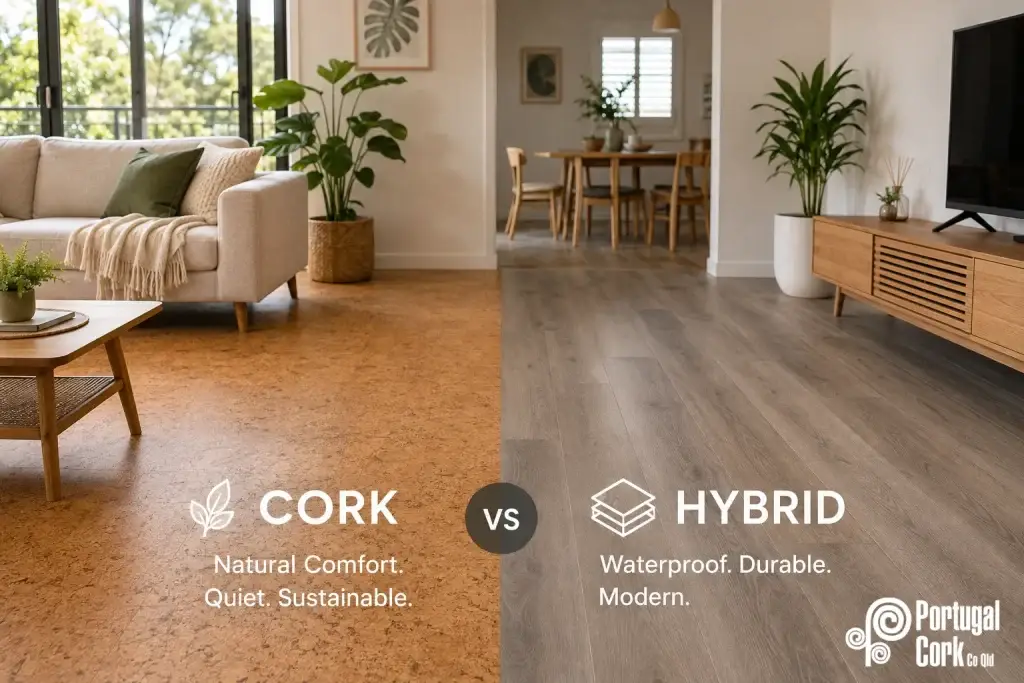
In the Australian flooring market, two names dominate the conversation right now: Hybrid and Cork.
On one hand, you have Hybrid flooring. It is the modern heavyweight, praised for being nearly indestructible and easy to click together. On the other hand, you have Cork, a classic material that has seen a massive design resurgence in 2026.
If you are renovating a Queenslander in Paddington or a modern apartment in South Brisbane, the choice you make today will affect your comfort for the next twenty years. Let’s look past the marketing fluff and see how these two actually stack up in the harsh Brisbane climate.
Before we dive into the comparison, we need to know what we are putting under our feet.
Hybrid flooring is a fusion of two popular choices: laminate and luxury vinyl plank (LVP). It usually features a stone plastic composite (SPC) core. It is rigid, waterproof, and designed to mimic wood.
Cork flooring is harvested from the bark of the Cork Oak tree. At Portugal Cork,we source ours directly from the Mediterranean. Unlike hybrid, which is afactory-made synthetic, cork is a biological marvel. It is made of millions of microscopic “honeycomb” cells filled with air. This tiny detail is the secret to almost every benefit cork provides.
Brisbane’s weather is famous for its “four seasons in one day” temperament, usually ending in a sweltering humid afternoon.
Hybrid flooring is a dense, stone-based product. This means it is a “thermal conductor.” In the middle of summer, if the sun hits a hybrid floor through a sliding glass door, that floor will hold onto the heat. It can feel like walking on a hot pavement.
Cork, however, is a “thermal insulator.” Because those millions of cells are filled with air, cork does not let heat pass through it easily. It stays remarkably consistent. In a humid Queensland summer, cork feels cool underfoot.In the rare chilly mornings of July, it doesn’t feel like an ice block.
If you want to reduce your reliance on air conditioning, cork is the best flooring for the Brisbane climate. It helps keep the ambient temperature of your room stable, which is a win for both your comfort and your electricity bill.
We don’t often think about “floor hardness” until we have spent three hours standing in the kitchen prepping a Sunday roast.
Hybrid flooring is incredibly hard. While this makes it durable, it offers zero “give.” Standing on it for long periods can lead to fatigue in your lower back, knees, and ankles. It is essentially like standing on a thin layer of plastic over a concrete slab.
Cork is nature’s shock absorber. When you step on a cork tile, it compresses slightly under your weight and then returns to its original shape. This “softness” is why cork was traditionally used in libraries and hospitals.
In 2026, as more of us work from home, the ergonomic benefit of cork is a game changer. It provides a natural anti-fatigue surface that makes a massive difference to your daily physical well-being.
If you have a dog with long nails or kids who love to run, you know the sound of a hard floor. Hybrid floors are notorious for being “loud.” Because they are dense and rigid, they reflect sound waves. This creates a sharp, echoing noise that can make a busy household feel frantic.
Cork is one of the best acoustic materials available. It doesn’t just look good; it acts as a sound-dampening sponge. It absorbs impact noise rather than reflecting it.
This is why many Brisbane apartment dwellers are moving away from hybrid. Even with a high-quality underlay, hybrid struggle to match the natural silence of a 6mm or 8mm cork tile. If you value a quiet, peaceful home environment, cork wins this round by a landslide.
A common question we get at Portugal Cork is: “Will cork warp in the humidity?”
It is a fair question. Brisbane’s humidity can reach 90% in the summer. Hybrid floors are often marketed as 100% waterproof, which is true. They won’t swell if you drop a bucket of water on them. However, they can still struggle with “expansion and contraction” if the house gets too hot, leading to gaps or buckling at the seams.
Cork is naturally resistant to moisture. It contains a waxy substance called Suberin, which prevents the material from rotting or absorbing water easily. When professionally sealed with a high-quality finish like Loba, a cork floor is incredibly resilient.
While hybrid might be better for a laundry room that floods weekly, cork is more than capable of handling the everyday spills and humidity of a family kitchen or living area.
Many homeowners are becoming more conscious of the chemicals used in their building materials. Hybrid floors are a chemical product. High-quality ones are safe, but cheaper versions can off-gas volatile organic compounds (VOCs) for months after installation.
Cork is the gold standard for sustainable flooring in Australia. It is non-toxic, anti-microbial, and naturally resistant to mould and mildew. It also doesn’t shed microplastics over time.
For families with asthma or allergies, cork is a breath of fresh air. It does not trap dust or pet dander like carpet, and it doesn’t have the chemical footprint of synthetic planks.
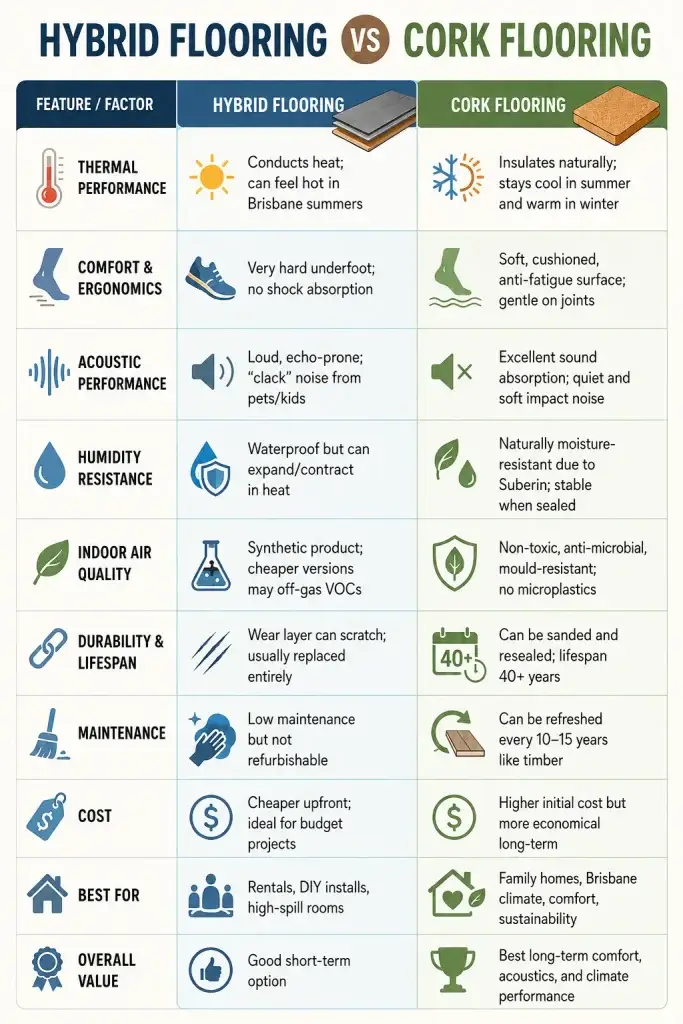
In the short term, hybrid flooring is often cheaper to purchase and install. It is a “commodity” product.
Cork is a premium, natural material. While the initial investment might be higher, you have to look at the lifespan. A hybrid floor is a “disposable” floor. Once the top wear layer is scratched or the clicking mechanism breaks, the whole floor usually needs to be replaced.
A cork floor can be sanded and resealed. Just like a solid timber floor, you can refresh it every ten to fifteen years, giving it a lifespan of 40 years or more. When you calculate the cost per year, cork is often the more economical choice.
Choose Hybrid if:
Choose Cork if:
There is only so much a screen can tell you. To truly understand why Brisbane homeowners are moving back to cork, you need to feel it.
At Portugal Cork, we have spent decades sourcing the finest Portuguese cork for Australian homes. Whether you are looking for the traditional warmth of standard tiles or the sleek, modern look of our premium range, we can help you find the perfect fit for your renovation.
View our range of Standard and Premium Cork Tiles and take the first step toward a cooler, quieter, and more comfortable home.